
1 Sep 2026
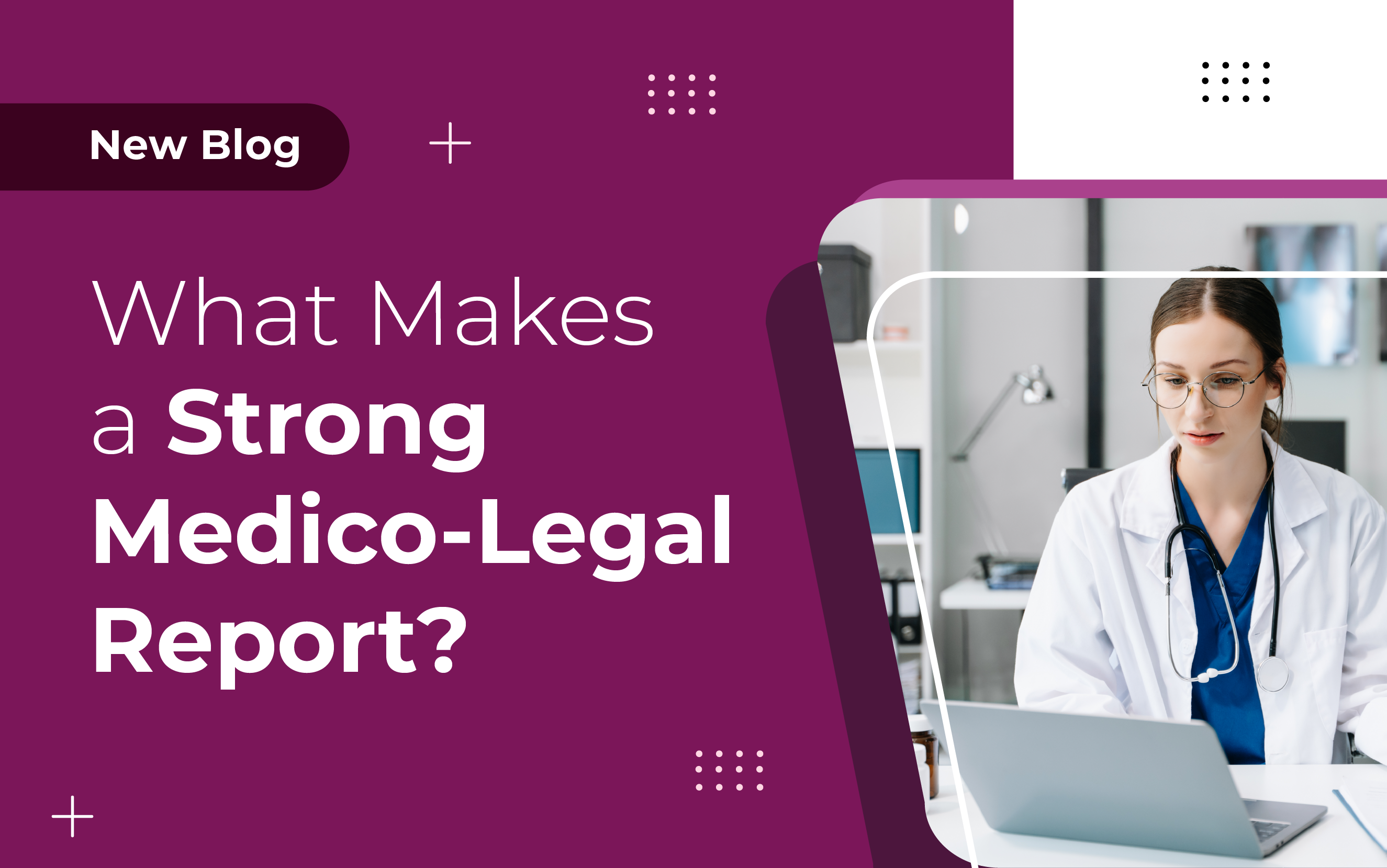
What makes a strong Medico-Legal Report?
For solicitors handling personal injury and clinical negligence claims, the quality of a medico-legal report can have a significant impact on how efficiently a case progresses and how confidently liability, causation and quantum can be assessed.
This is because a strong report can not only work to confirm a diagnosis, but it can also provide clear, objective medical evidence, explain the relationship between the incident and the reported symptoms, assess the impact on daily life and offer a reasoned opinion on prognosis and future treatment needs.
As a result, understanding what makes a robust medico-legal report is essential for legal professionals when it comes to selecting experts, reviewing evidence and advising clients.
What is a medico-legal report?
A medico-legal report is an independent medical assessment prepared for legal purposes.
It is produced by a suitably qualified medical expert who has reviewed the relevant records, examined the claimant and provided an evidence-based opinion on the injuries or condition in question, and depending on the nature of the claim, it may address:
- The diagnosis and severity of the injury
- Whether the symptoms are consistent with the reported incident
- The likely recovery period and long-term prognosis
- The impact on work, daily activities and quality of life
- And/or if any further treatment, rehabilitation or specialist assessment is required
But above all, the report forms an important link between medical evidence and legal analysis, helping solicitors, insurers and the courts understand the clinical aspects of a case in a structured and accessible way.
What makes a strong medico-legal report?
Clear and accurate medical evidence is the foundation of any strong medico-legal report, and the expert should clearly distinguish between the claimant’s account, the findings observed during examination and the information contained within the medical records, an important distinction as it allows legal professionals to assess the reliability and consistency of the evidence while reducing ambiguity or misunderstanding.
A thorough medical history is also essential, especially as the expert should consider pre-existing conditions, previous injuries, treatment history, current symptoms and any relevant ongoing medical issues, and any clinical examinations should then be documented in sufficient detail to support the expert’s conclusions.
This means that any findings relating to mobility, neurological function, range of movement or other functional limitations should be clearly recorded rather than simply summarised as “normal” or “restricted”, and it is this level of detail which helps ensure that the conclusions reached are properly supported by objective findings.
But one of the most common frustrations for legal professionals is receiving a report that states a diagnosis without explaining its significance.
This is particularly important in cases involving soft tissue injuries, chronic pain, psychological symptoms or mild traumatic brain injuries, where the functional impact may not be immediately obvious from the diagnosis alone.
Because of this, any expert’s opinions must be supported by the available evidence, and all conclusions on causation, prognosis and future treatment should be reasoned and proportionate rather than speculative.
For example, if ongoing symptoms are considered attributable to the accident, the expert should explain how the history, examination findings and medical records support that conclusion. Equally, if symptoms are more likely related to a pre-existing condition or another contributing factor, this should be clearly stated too.
And finally, a useful and credible medico-legal report should also provide practical guidance on future expectations, as solicitors need to understand not only the claimant’s current condition but also what is likely to happen next.
This includes having a strong prognosis section which clearly addresses whether full recovery is expected, the anticipated timescale for improvement, the likelihood of ongoing symptoms and whether further treatment or rehabilitation is reasonable and necessary.
Together, all these recommendations should help avoid unnecessary follow-up questions and support more accurate valuation of the claim.
What should solicitors look for in a medico-legal report?
Solicitors should consider several key factors when reviewing a medico-legal report, including whether the expert holds the appropriate expertise and qualifications to begin with.
For example, an orthopaedic injury should be assessed by an appropriately experienced orthopaedic expert, whereas psychological injuries should be assessed by a suitably qualified psychiatrist or psychologist, as this helps ensure that the opinions provided are credible, defensible and consistent with current clinical practice.
As well as this, a high-quality medico-legal report must also be independent, as the expert’s duty is to the court, not to the instructing party.
Here, objective reporting works to strengthen the credibility of the evidence and reduces the risk of challenge from the opposing side, and any reports that appear partisan or argumentative can undermine both the expert’s evidence and the wider case strategy.
Clear, accessible language is an essential factor too, as whilst medical terminology is sometimes unavoidable, the best reports explain technical concepts in plain English where possible and avoid unnecessary jargon.
As a result, this clear language improves efficiency, reduces the need for clarification and helps all parties engage with the medical evidence more effectively, but it also maintains thoroughness and attention to detail too, including accurate chronology, consistent recording of symptoms, consideration of the relevant records and clear explanation of any inconsistencies identified during the assessment process.
What are the common issues with weaker medico-legal reports?
Reports that fall below the required standard can create delays, increase costs and lead to requests for clarification or supplementary evidence, with common problems often including:
- Missing medical history or examination findings
- Vague or inconsistent conclusions
- Insufficient explanation of causation or prognosis
- Or the general failure to address the claimant’s functional impact, including work, driving, mobility and everyday activities
A diagnosis alone rarely provides enough information to assess the true value or complexity of a claim. Understanding how the injury affects the claimant’s ability to function on a day-to-day basis is often essential when evaluating damages and future needs.
The role of the medico-legal provider
The quality of a medico-legal report depends not only on the expert but also on the systems supporting the reporting process, and an effective medico-legal provider should offer careful expert selection and case matching to ensure that each instruction is allocated to an appropriately qualified specialist with relevant reporting experience.
As well as this, quality assurance processes are equally important, particularly as reviewing reports for omissions, inconsistencies and formatting issues before release helps improve accuracy and reduces the need for costly amendments or supplementary reports.
Finally, efficient case management is another key consideration to be mindful of, as prompt appointment coordination, regular progress updates, timely delivery of reports and responsive communication all contribute to smoother case progression and help solicitors meet litigation timetables more effectively.
Delivering reliable medico-legal reports
At Speed Medical, we understand that solicitors need medico-legal reports that are clear, objective and robust enough to support effective decision-making, which is exactly why our approach combines access to an experienced panel of appropriately qualified medical experts with structured quality assurance and dedicated case management support.
Then, by carefully matching experts to the specific requirements of each case and maintaining a strong focus on accuracy, consistency and communication, we can help legal professionals obtain reliable medical evidence that supports efficient case progression and informed outcomes.
For more information or to run through any questions about medico-legal reports with our teams, please visit Speed Medical, contact us via email at info@speedmedical.com or call 0330 094 8749 – we’re here to help.